
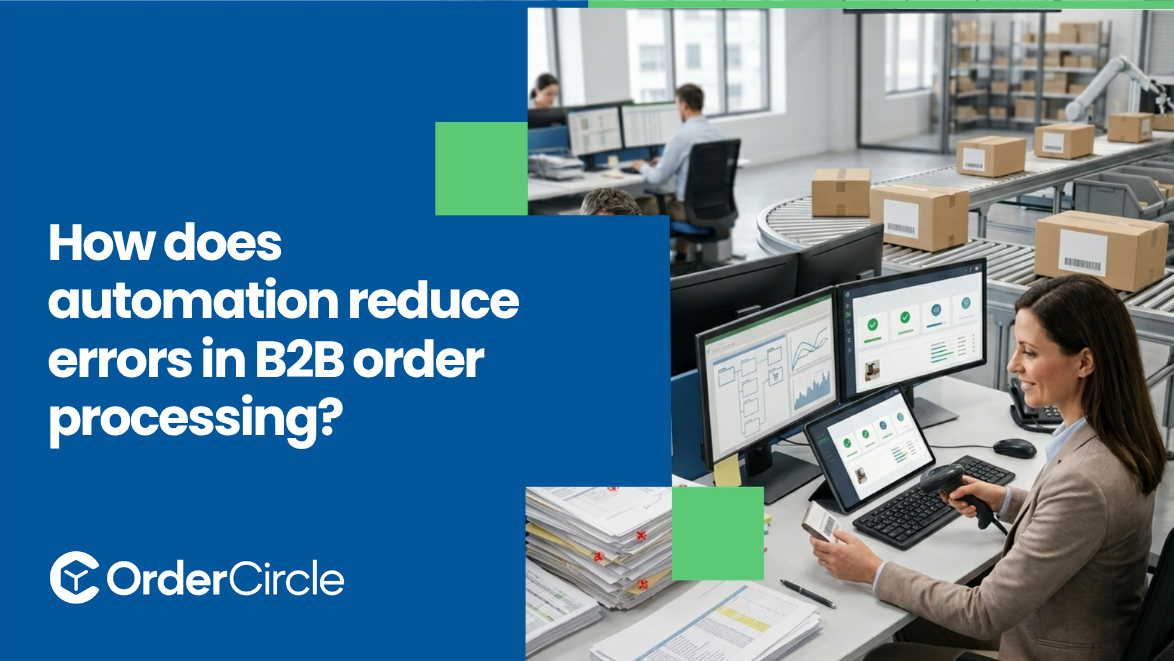
Order processing mistakes can create bigger problems than most businesses realize. A wrong price, incorrect quantity, or outdated inventory count can lead to delays, unhappy customers, and lost sales. The more orders your team handles, the harder it becomes to avoid these errors manually.
Automation reduces these risks by handling repetitive tasks automatically. It keeps inventory, pricing, and order data connected in real time, helping businesses process orders faster, improve accuracy, and deliver a smoother experience for their customers.
Core Takeaways
- Most B2B order errors originate at manual data entry points and automation eliminates those entry points.
- Automated order capture, real-time inventory validation, and pricing rule enforcement together eliminate the most common sources of B2B order errors.
- A single order error in B2B typically triggers returns, reshipping, correction labor and in some cases chargeback penalties from large buyers.
- Businesses that automate order processing report significant reductions in correction time and measurable improvements in order accuracy rates.
- Automation drives faster fulfillment cycles, and stronger buyer relationships are a direct outcome of getting orders right the first time.
The Common Causes of Errors in B2B Order Processing
Most B2B order errors do not come from system failures. They come from the manual steps that sit between systems. Here is where they consistently originate.
Manual Data Entry and Re-Keying From PDFs and Emails
A significant portion of B2B purchase orders still arrive as PDF attachments or email bodies. Someone on the operations team reads the document and manually enters the order details into the system. That transcription step is where errors enter.
Common examples include wrong quantities, transposed product codes, and missed line items. The data in the original order was correct. The re-keying introduced the mistake. At high order volumes, this happens constantly and the errors compound faster than most teams can catch them.
Pricing and Discount Mistakes
B2B pricing is rarely straightforward. Different buyers have different contracted rates, volume discounts and promotional agreements that change regularly. When pricing gets applied manually by referencing spreadsheets or memory, mistakes happen.
A rep applies the wrong tier. A discount expires but nobody updated the reference sheet. The order goes out priced incorrectly and the dispute that follows costs more to resolve than the margin difference that caused it.
Inventory Discrepancies at the Point of Order
When inventory data lives in a separate system from order entry and the two are not connected in real time, orders get placed against stock that is not actually available. The buyer gets a confirmation, the warehouse cannot fulfill it and the correction process starts. This is one of the more damaging error types because it creates broken delivery promises rather than just paperwork issues.
Miscommunication Between Sales and Fulfillment Teams
Sales commits to a delivery date or a custom configuration. That commitment does not make it into the order record accurately. Fulfillment ships the standard version or misses the timeline. The buyer receives something different from what was agreed. These errors are harder to catch in automated validation because they originate in conversations that never got documented properly in the first place.
How Automation Removes Each of These Errors
Each of the error sources above has a direct automation fix. Here is how they get addressed:
Automated Order Capture and Data Extraction
Instead of a team member reading a PDF and typing the details manually, automated order capture pulls the data directly from the incoming document and maps it into the system. Product codes, quantities, delivery addresses and line item details get extracted without a human transcription step in between. The source data goes straight into the order management software without anyone touching it. That single change eliminates the most common entry point for B2B order errors.
Real-Time Inventory Validation at the Point of Order
When inventory data connects directly to the order entry system, availability gets checked the moment an order comes in rather than hours later when fulfillment picks it up. If an item is out of stock or below the required quantity, the system flags it immediately before the confirmation goes to the buyer. No broken promises, no last-minute scrambles and no buyer receiving a shipment notification for an order that cannot be fulfilled.
Automated Pricing Rules and Contract Enforcement
Purchase order management systems that store customer-specific pricing, volume tiers and contract terms apply those rules automatically at the point of order. There is no manual lookup, no spreadsheet reference and no rep making a judgment call on which rate applies. The correct price gets applied every time based on who the buyer is and what their current agreement says. Pricing disputes drop significantly when the rules are enforced by the system rather than by people.
Direct System-to-System Handoffs Without Manual Steps
Order management solutions that integrate directly with ERP, warehouse and fulfillment systems pass order data between departments without anyone re-entering it at each stage. Sales commits to something, it goes into the system and fulfillment sees exactly what was agreed upon without a separate communication step. The manual handoff where information gets lost or misinterpreted disappears entirely when the systems talk to each other directly.
What Businesses Actually Gain When Order Errors Are Removed
Reducing order errors is not just an operational improvement. The gains show up across the entire business in ways that compound over time.
Faster Order Fulfillment Cycles
Every correction slows the fulfillment process down. Someone has to identify the error, track down the right information, fix it in the system and restart the fulfillment step that got interrupted. When errors drop, that correction loop disappears and orders move straight through from entry to shipment without interruption.
Stronger Buyer Relationships
A buyer who receives the wrong product, a misquoted invoice or a late shipment because of an internal processing error starts looking at alternatives. Consistent order accuracy builds the kind of operational trust that makes buyer relationships sticky. It is not a soft benefit. Retained accounts and repeat order volume have real revenue attached to them.
Staff Time Redirected to Higher Value Work
Order correction is one of the most labor-intensive and least valuable ways a B2B operations team can spend its time. When errors drop, the hours previously spent tracking down mistakes, coordinating corrections and managing buyer complaints become available for work that actually moves the business forward. Customer relationship management, process improvement and new account onboarding. The capacity was always there. It was just absorbed by preventable errors.
Read Also: Can b2b inventory software manage bulk and wholesale stock?
Conclusion
B2B order errors follow predictable patterns that trace back to manual entry points and disconnected systems. Automation removes those vulnerabilities at the source. The result is faster fulfillment, more accurate orders, and buyer relationships that withstand high-volume pressure.
If your team is spending time correcting orders that should have been right the first time, OrderCircle has the tools to fix that. Explore the platform and see how it manages order capture, pricing enforcement and fulfillment for B2B operations built to scale.
FAQs
What types of errors does B2B order automation prevent most?
Manual re-keying mistakes, incorrect pricing application, inventory discrepancies at the point of order and miscommunication between sales and fulfillment. These four account for the vast majority of B2B order errors.
How long does it take to see results after implementing B2B order automation?
Many businesses begin seeing improvements in order accuracy shortly after implementation, though results vary based on process complexity and system integration. The speed depends on how integrated the automation is with existing systems. Companies that connect order capture directly to their ERP and inventory data typically see the fastest and most significant improvements in accuracy.
Does automation work for businesses with complex pricing structures?
Yes, and complex pricing is actually where automation adds the most value. Storing each buyer's contracted rates and applying them automatically at the point of order removes the manual judgment calls where pricing mistakes consistently happen.
.svg)


