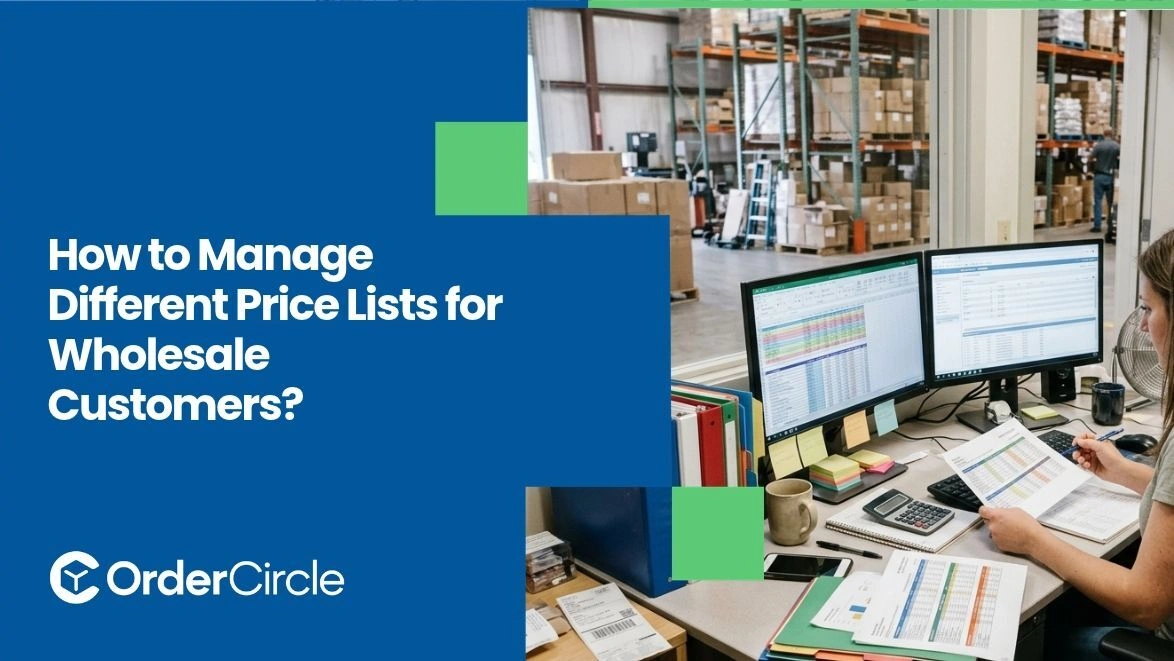
A wholesale buyer logs into your portal, sees pricing that's 8% higher than expected, and immediately questions the order. Wholesale price lists help businesses manage different rates for different customers, from volume discounts and negotiated contract pricing to regional rates and special terms for key accounts.
Managing them effectively requires a clear base price, well-organized pricing tiers, rules that determine which customers see each list, and a consistent update process. The challenge is keeping prices accurate and preventing conflicts across customer accounts.
Key Takeaways
- Start with one base price list. Every other list is a variation of that single source, which keeps updates consistent and auditing simple down the line.
- Group customers by pricing tier (volume, region, account type) and let the matching list get assigned automatically. Case-by-case pricing scales badly past 50 accounts.
- Updates need an effective date, an approval step, and a version log. Price changes that quietly ship on a Tuesday afternoon are how customer disputes start.
- Audit prices quarterly against actual invoices. The gap between what the system should charge and what it actually charges shows where margin leaks occur.
Ways to Set Up and Organize Multiple Wholesale Price Lists
Setting up multiple price lists starts with structure, not spreadsheets. Four early decisions save hours of cleanup later when the business adds more accounts.
Establish a Base Price List for Your Products
Every pricing structure needs one base. This is your standard wholesale price, the number everything else references. Volume discounts are percentages off the base. Contract pricing overrides the base. When the base changes, every derived list updates in a predictable way. Without a base, each list drifts independently and reconciliation becomes a nightmare.
Segment Wholesale Customers by Pricing Requirements
Not every account needs its own list. Group them by what actually drives their pricing. Volume tier (orders over $10k monthly, $50k monthly, $100k+ monthly). Region (East Coast, West Coast, international). Account type (distributor, retailer, direct). The segments stay small enough to manage and specific enough to apply the right pricing.
Create Separate Price Lists for Special Agreements
Some customers negotiate pricing that doesn't fit any standard tier. A key account on a two-year contract with locked-in pricing. A promotional partner with 20% off a specific SKU range. Create a dedicated list for each of these rather than hacking it into a tier list. Clean separation prevents one special deal from accidentally bleeding into another account.
Organize Price Lists by Product, Market, or Currency When Needed
Scale eventually calls for more dimensions. Separate lists by product line when they have different pricing logic (private label vs. branded). Separate by market when regional pricing varies. Separate by currency when you sell internationally. The rule of thumb: add a dimension when the pricing within a current list stops making sense together.
How to Assign the Right Price List to Each Wholesale Customer
Lists only work if the right customer sees the right one at the right time. Three mechanisms handle the assignment logic across most wholesale operations.
Assign Price Lists Through Customer Groups
Customer groups do the heavy lifting. Create a group for each pricing tier (gold, silver, bronze, or whatever names fit) and assign the matching price list to the group. Place new customers in a group during onboarding. Their pricing follows automatically. One decision at setup time replaces endless manual pricing on every order.
Apply Individual Prices to Customers With Negotiated Terms
Customer group pricing covers most accounts. For the ones with negotiated agreements, override at the individual customer level. The customer's record carries the override, and it takes precedence over the group list for that account only. Document what was negotiated, when, and by whom. Overrides without context become headaches two years later.
Set Rules for Customers Who Qualify for Multiple Price Lists
Sometimes a customer qualifies for a volume tier, a regional discount, and a promotional list all at once. Decide the stacking rule in advance. Options include: lowest price wins, specific-override-general, promotional takes precedence for a window, or additive discounts up to a cap. Pick one logic. Hard-code it. Avoid case-by-case decisions.
How to Update Wholesale Price Lists Without Creating Errors
Changing prices across hundreds or thousands of SKUs is where errors sneak in. Four practices keep the update process clean and auditable from end to end.
Use Bulk Price Updates for Large Product Catalogs
When you need to raise prices across 2,000 SKUs by 3%, nobody should be editing them one at a time. Bulk update tools let you apply percentage changes, flat increases, or absolute values across filtered groups. Preview the full change set before committing. Export the diff for your records.
Set Effective Dates for New Prices and Contract Changes
Future-dated prices let you load changes now and have them take effect automatically on an agreed date. A customer on a one-year contract gets the new rate on the renewal date, not whenever an admin remembers to update it. Effective dates also let you back-date reporting against the pricing that was actually in effect.
Establish a Pricing Approval Process
Not every price change should sit in one person's hands. Add an approval step for changes above a threshold: any contract pricing, or any update over 5%. The approver doesn't have to be the one making the change. Separation of duties catches typos and intentional overreach before anything hits a customer invoice.
Maintain Version History and Communicate Changes
Every price list should carry its own version log. What changed, when, by whom, what the previous value was. When a customer disputes a price, the history tells the story. Communicate upcoming changes 30 to 60 days ahead for contract customers, not when the first invoice arrives at the new rate.
How to Prevent Pricing Conflicts and Protect Wholesale Profit Margins
Pricing conflicts show up in a few predictable places. A customer sees one price in the portal and gets invoiced at another. Two systems disagree on what a specific customer should be charged. A promotional discount applies when it shouldn't.
The root cause is pricing data living in multiple places that don't communicate properly. Your ERP, your B2B portal, your sales rep's spreadsheet, your accounting software. Fix the structure: one source of truth, every system reading from it, no local overrides without documented reasons.
Margin protection comes from visibility. Report realized margin by customer monthly. If an account's margin keeps slipping below target, something in the pricing structure isn't working as intended.
How to Audit Wholesale Price Lists and Maintain Pricing Accuracy
Pricing accuracy drifts without regular checks. Build quarterly audits into the ops calendar before small discrepancies become customer disputes.
Pull a sample of invoices from the past quarter. Compare each line item's price to what the system says the customer should have been charged. Flag every mismatch. Investigate the pattern. Did an override expire without removal? Did a promotional discount apply after its window closed?
The audit usually surfaces one or two systemic issues worth fixing permanently. Address them at the source rather than correcting invoice by invoice. A good audit also catches opportunities for raising prices on accounts that have outgrown their original tier.
Conclusion
Managing multiple wholesale price lists cleanly comes down to structure: one base list, well-defined tiers, automatic assignment through customer groups, individual overrides for negotiated accounts, and discipline on updates. Add regular audits, effective dates, and version history on top of that foundation. The whole pricing operation stays trustworthy as the account base grows and renewal season comes around.
If you're looking for a wholesale platform that handles customer-specific pricing, tier management, and price list updates in one connected system, OrderCircle gives wholesale brands a central place to manage pricing alongside orders, inventory, and invoicing. Start the free 14-day trial.