A B2B ecommerce portal is almost always more efficient than traditional wholesale ordering. Portals cut entry time, remove data-entry errors, and give both sides live access to inventory, invoices, and shipment status. Traditional phone and email ordering still fits very small customer books or complex custom work. It struggles once volumes grow.
The real comparison comes down to volume, order complexity, and what your team spends its day on. For most wholesale operations, choosing a B2B ecommerce portal over traditional ordering is less about preference and more about scale.
Key Takeaways
- Portals handle order entry, pricing, inventory sync, and invoicing automatically. Traditional phone and email methods push each of those steps onto a human.
- Order accuracy improves when buyers see current pricing and stock as they build the order themselves, without typos from phone transcription or missed email replies.
- Phone, email, and fax ordering still fits one-off custom orders, long-standing relationships with a small handful of customers, or situations where the buyer wants a conversation first.
- Switching to a portal pays off when order volume climbs steadily, your team spends more time on data entry than selling, or customers start asking for self-serve access.
What Is a B2B Ecommerce Portal vs Traditional Ordering?
Both terms get used loosely. One is a software-driven ordering channel for business buyers. The other is how wholesale orders moved before portals existed.
What Is a B2B Ecommerce Portal?
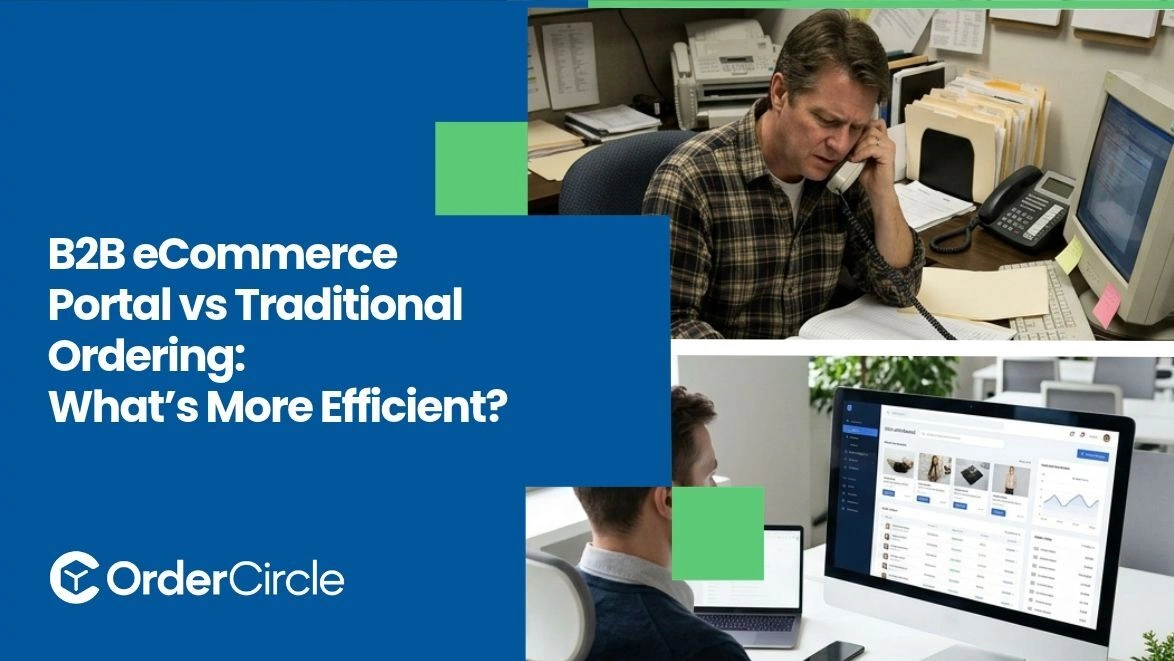
A B2B ecommerce portal is a self-serve online storefront built specifically for wholesale buyers. Business customers log in with their own account, see tier-specific pricing, browse real-time stock, and place orders without picking up the phone.
A B2B ecommerce portal can integrate with inventory, invoicing, and shipping systems to streamline order management and reduce manual work. An order placed at 2 a.m. shows up on the operations dashboard with the right discount already applied.
How Does Traditional Wholesale Ordering Work?
Traditional wholesale ordering runs on human-to-human communication. A buyer calls a sales rep, emails an order sheet, or sometimes faxes a signed PO. The rep enters the order into the system, checks stock manually, pulls up the customer's negotiated pricing, confirms by email, then sends a separate invoice once the shipment leaves. Traditional ordering often involves multiple manual steps, although businesses may use software to manage pricing, inventory, invoicing, and follow-up.
B2B Ecommerce Portal vs. Traditional Ordering: Which Ordering Method Is More Efficient for Wholesale Businesses?
Efficiency isn't a single number. It's five separate measures that compound as volume grows. On each of those measures, portals and traditional ordering diverge sharply.
Order Processing Speed
An integrated B2B portal can send orders directly into the fulfillment workflow, apply customer-specific pricing, and check available stock. Processing speed depends on system integrations, order complexity, and whether manual approval is required. Traditional ordering adds a bottleneck at every stop.
Manual order processing is limited by staff availability and the time required to handle each order. A well-configured B2B portal can process multiple incoming orders simultaneously, reducing delays as order volumes increase.
Order Accuracy and Fewer Errors
Transcription errors are the hidden tax of traditional ordering. Someone misreads a SKU on a faxed PO. A rep types the wrong quantity from a voicemail. Portals remove most of those failure points. The buyer picks items from the actual catalog, sees current prices, and confirms the total before submitting. Mistakes can still occur from incorrect product selections, outdated information, or system issues, but portals reduce errors from manually transferring order details.
Administrative Workload and Operating Costs
Portals shift the input work from your team to the buyer. The buyer writes the order. Your team confirms and ships it. That changes what each hire costs you. One portal-savvy ops person can oversee the orders ten reps used to type in by hand. The savings compound in less obvious places too: fewer duplicate orders, fewer invoice disputes, less time reconciling payments against handwritten POs.
Customer Convenience and Ordering Experience
Wholesale buyers aren't sitting around hoping for a sales call. They want to place an order while walking the shop floor at 7 a.m. or restocking a warehouse on a Sunday. A portal gives them that. They log in, see their price list, check inventory, place the order, and get a confirmation before their coffee cools. For a buyer managing 15 vendors, the one who makes ordering painless wins the next renewal.
Inventory, Invoices, and Order Tracking
Portals turn these from separate back-office jobs into a single connected view. When connected to inventory and accounting systems, a B2B portal can display updated stock information and generate invoices automatically according to the business's billing workflow. The customer tracks the shipment through the same login they used to place the order. Traditional ordering may involve separate systems and extra manual coordination, which can lead to more handoffs, processing delays, and customer inquiries.
When Does Traditional Wholesale Ordering Still Make Sense?
Portals aren't the right answer for every operation. If you have 10 wholesale customers who've all bought the same thing for 15 years, a portal is probably overkill. The relationship runs on familiarity. A rep knows what each buyer wants without them having to type it out.
Custom-manufactured goods also rely on traditional ordering. When every order needs a conversation about specs, tolerances, or lead times, a portal menu can't carry the complexity. The buyer and rep still need to work the details out together.
Niche industries with strict compliance requirements sometimes stick with faxed POs because their auditors expect them. A regulated workflow built around wet signatures or stamped forms can create more paperwork online than off.
When Should a Business Switch to a B2B Ecommerce Portal?
The signs usually show up before the pain gets severe. Watch for a few patterns in your current workflow. These are the ones that tell you the manual process has stretched past its useful limit.
Order volume keeps climbing, but you're hiring more staff just to keep up with order entry. Reps spend more time typing POs than talking to customers. Manual-entry errors are hurting margins. Customers are asking why they can't just log in and order themselves.
Any one of those is a signal. Two or three together means the switch is overdue. The investment usually pays back through reduced labor on order entry and fewer disputes from errors. Pick a platform that connects to your existing accounting, shipping, and inventory tools.
Conclusion
The efficiency gap between a modern B2B portal and traditional phone, email, and fax ordering keeps widening. Portals let buyers self-serve, keep pricing and inventory accurate with minimal effort, and free your team to focus on sales instead of order entry. Traditional methods still fit certain custom or small-batch operations. For wholesale businesses facing increasing order volumes and administrative workloads, a B2B portal can provide a more scalable and sustainable ordering solution.
If a connected B2B platform is the next step for your wholesale operation, OrderCircle brings ordering, customer accounts, invoicing, and inventory into one portal. Start the free 14-day trial and see the difference.